A Month of London Through Teenage Eyes


When I moved to London, one of the things I looked forward to most was eventually sharing it with my son.
Not just bringing him here for a holiday, or marching him past a checklist of famous landmarks, but letting him see the full shape of the city I’ve come to love. The grand, historic version everyone recognizes, the quiet corners I’ve discovered, and the ordinary places where my life actually happens.
This summer, Nikolai made his first international trip and spent a month with me in London.
He’s fourteen now and, somehow, several inches taller than me—a fact he seems entirely too pleased about. I had to keep reminding myself, while looking up at him on the Tube, that this was the same kid I once carried around on my hip. Now he was navigating escalators, reading Underground maps, and following me through one of the largest cities in the world as though he had always belonged here.
I wanted his first experience of London to be well-rounded, so naturally I planned enough activities to exhaust a much more athletic family.
We did a proper tourist’s London. Elizabeth Tower, Westminster, the London Eye, museums, theatre, long walks, and far too many Tube journeys to count. We looked out across the city from the Sky Garden, wandered through the Wallace Collection, survived the London Dungeon, watched a light show at Westminster Cathedral, escaped to the coast at Seven Sisters, and spent an unforgettable evening at Harry Potter and the Cursed Child.
There is something uniquely enjoyable about introducing someone to a place you adore. Even familiar streets feel new again. I found myself watching Nikolai almost as much as I watched whatever we had come to see, waiting to find out which things would capture him and which would earn the restrained teenage response of, “Yeah, that was cool.”
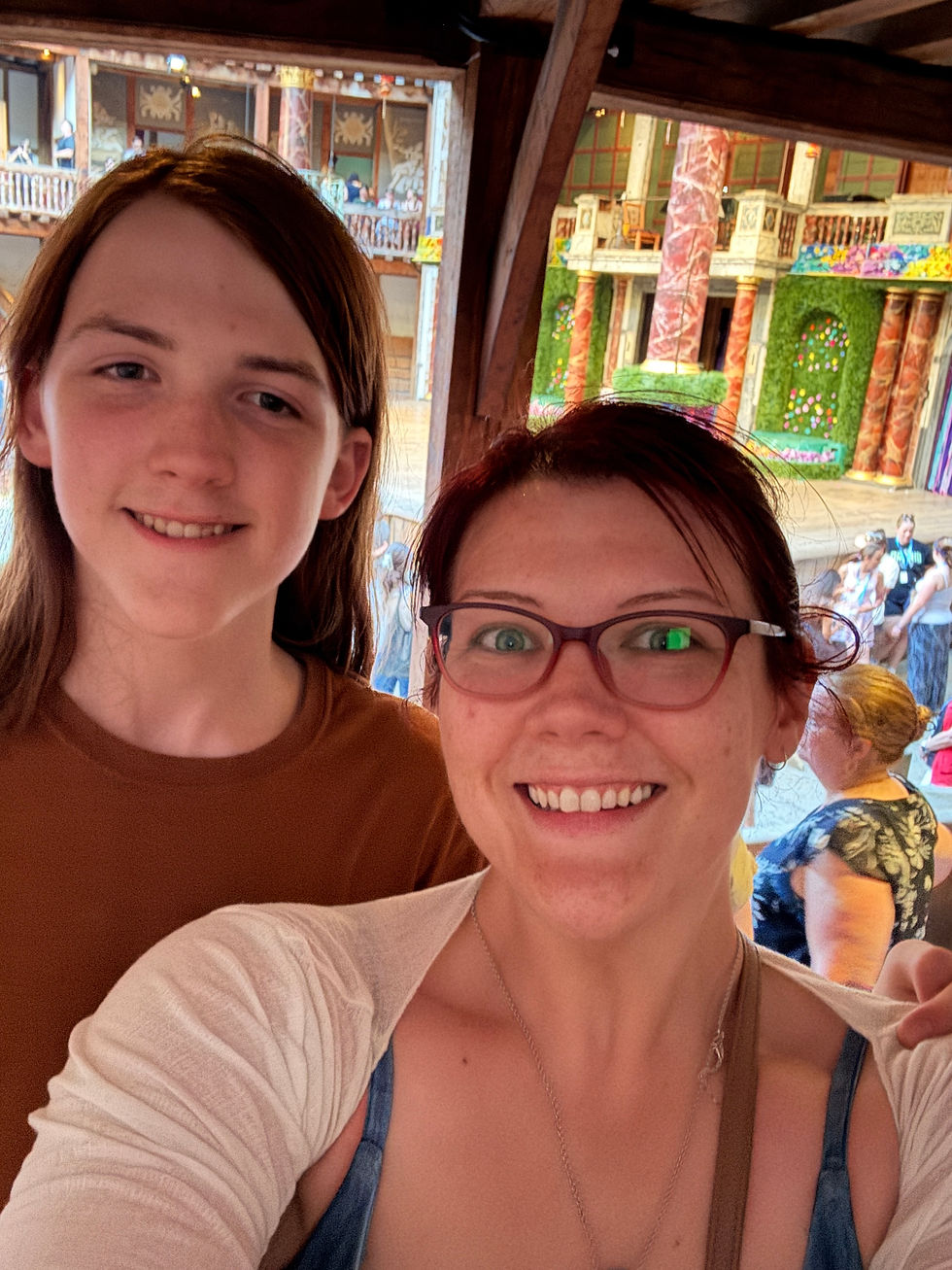
One of my favorite moments came at Shakespeare’s Globe, where we saw A Midsummer Night’s Dream.
The Globe was one of those experiences I desperately wanted him to enjoy but knew I could not force. You can provide a child with culture, history, and Shakespearean theatre, but you cannot compel enthusiasm once they are old enough to recognize parental propaganda.
Fortunately, I didn’t need to.
Afterward, Nikolai told me he had loved it. He also admitted that he had not realized Shakespeare wrote comedies.
Apparently, somewhere along the way, education had left him with the impression that Shakespeare’s primary occupation was writing tragedies about doomed people speaking in complicated sentences before everyone died.
Watching him discover that Shakespeare could be playful, ridiculous, and genuinely funny was one of the highlights of the entire month. The production was joyful, strange and energetic, and hearing him say he loved it made the evening feel like a small victory—not because he had appreciated something “educational,” but because I got to watch the boundaries of his world stretch outward a little.
We also ventured beyond London to Avebury and Stonehenge, giving Nikolai his first encounter with the ancient landscape that surrounds the city. He said he'd wished we had longer to explore, and I agree. I never feel like I have enough time.
Another unexpected highlight was Chislehurst Caves.
The caves were incredible: dark, cool, winding, and full of the suggestion that there was always more waiting just beyond where we were allowed to explore. Nikolai loved them, and so did I. We both left wanting to see more, which is generally the mark of a good adventure.
The caves also offered a glorious break from the heat, because of course Nikolai happened to arrive in the middle of an atrocious London heatwave, poor kid.
London is not built for heat. The city seems to view air conditioning as an unnecessary modern indulgence, and we were staying on the top floor of an unairconditioned house, where every degree of heat rose dutifully upward and settled into our rooms.
By the hottest part of the day, the house felt like a Victorian punishment designed to build character, or sweat out the demons in your blood.
We began escaping regularly to Queen’s Wood. We would pack a lunch, find a shady place beneath the trees, and spend the afternoon reading. The woods became our hideout from the heat and from the constant movement of the city—a cool, green pocket where we could slow down for a few hours.
It's also where we befriended a family of crows by bringing them food, like fruit and unsalted nuts. Each time we went back, we fed the same birds. Nikolai loved watching them, learning their behavior, and seeing how quickly they came to expect us. Out of everything we did in London—the museums, the theatres, the famous landmarks—the crows in Queen’s Wood were one of his favorite parts. (Similar to when your kid's favorite part of the Christmas present is the box it came in, gotta admit)
More than sightseeing (and bird watching). I wanted him to see the London I live in.
He came with me to the pub where I eat pizza with my friends. He attended one of the writing workshops I take part in and met some of the people who have become part of my life here. He came to a reading event on campus and watched me stand in front of an audience to read one of my short stories. That moment mattered to me more than I expected.
My son has always known that I write. He’s grown up around notebooks, drafts, books, deadlines, and my tendency to stare into space because I am mentally rewriting a sentence. But there is a difference between knowing your mom is a writer and seeing her inhabit that part of herself in the world.
Having him on campus, watching me read my work aloud, made the different pieces of my life feel briefly joined together. The mother I am to him, the student I am at university, and the writer I have fought so hard to become were all allowed to exist in the same room.
Over the course of the month, I watched Nikolai form his own impressions of London.
One of the things he mentioned most was the diversity of the city. He loved how many different kinds of people live here, how many languages he heard, and how everyone seemed free to go about doing their own thing.
London can be crowded, loud, impatient, and occasionally baffling, but it also grants a certain anonymity that can feel like freedom. No one is paying quite as much attention to you as you fear they might be. Everyone is busy living their own strange, complicated life. I was glad he noticed that.
By the end of the month, we had filled our days with museums, theatre, history, caves, food, trains, long walks, overheated rooms, and woodland lunches. We had looked over London from the sky and wandered beneath the earth.
I wanted to give Nikolai a full view of the city I love. What I had not expected was how much I would enjoy seeing it reflected back through him.
London felt different with my son beside me—more vivid, perhaps, or more complete. For one month, I was able to bring together the life I came from and the life I am creating. I showed him my favorite city, and he reminded me why I fell in love with it in the first place.
Then he stood beside me in photographs, several inches taller than I am, just to make sure I did not become overly sentimental.


